


-
Book Overview & Buying
-
Table Of Contents

-
Feedback & Rating

C++ High Performance
By :


C++ High Performance
By:
Overview of this book
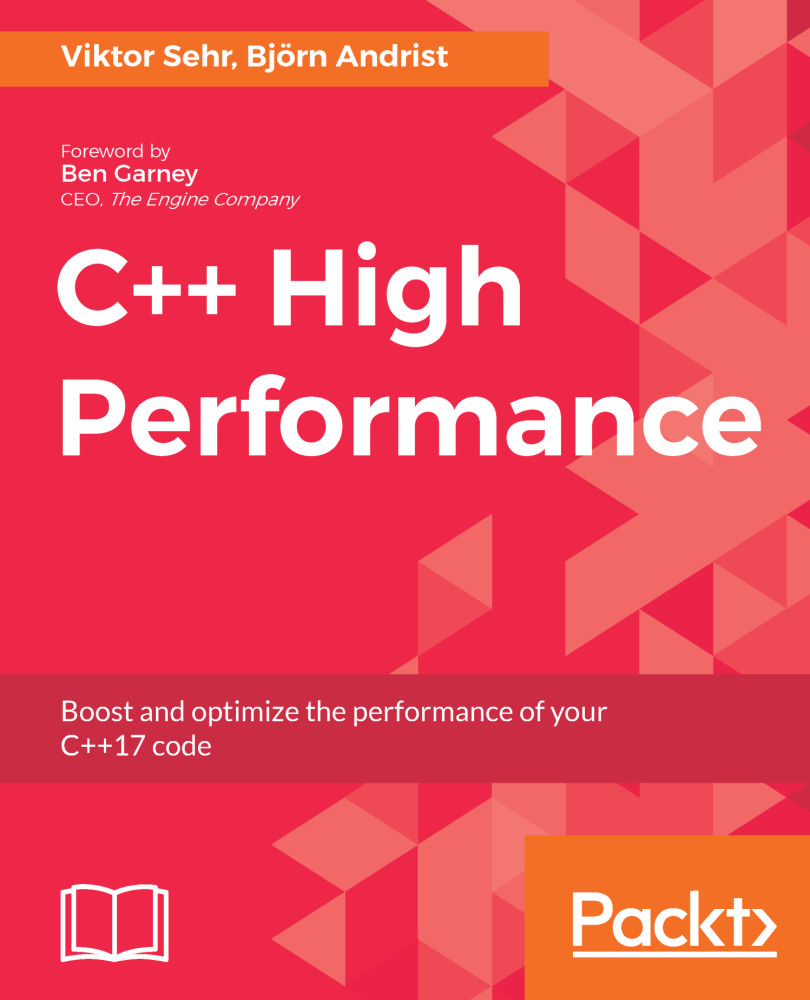
C++ is a highly portable language and can be used to write both large-scale applications and performance-critical code. It has evolved over the last few years to become a modern and expressive language. This book will guide you through optimizing the performance of your C++ apps by allowing them to run faster and consume fewer resources on the device they're running on without compromising the readability of your code base.
The book begins by helping you measure and identify bottlenecks in a C++ code base. It then moves on by teaching you how to use modern C++ constructs and techniques. You'll see how this affects the way you write code. Next, you'll see the importance of data structure optimization and memory management, and how it can be used efficiently with respect to CPU caches. After that, you'll see how STL algorithm and composable Range V3 should be used to both achieve faster execution and more readable code, followed by how to use STL containers and how to write your own specialized iterators.
Moving on, you’ll get hands-on experience in making use of modern C++ metaprogramming and reflection to reduce boilerplate code as well as in working with proxy objects to perform optimizations under the hood. After that, you’ll learn concurrent programming and understand lock-free data structures. The book ends with an overview of parallel algorithms using STL execution policies, Boost Compute, and OpenCL to utilize both the CPU and the GPU.
Table of Contents (19 chapters)
Title Page


Copyright and Credits
Packt Upsell
Foreword
Contributors
Preface
 Free Chapter
A Brief Introduction to C++
Modern C++ Concepts
Measuring Performance
Data Structures
A Deeper Look at Iterators
STL Algorithms and Beyond
Memory Management
Metaprogramming and Compile-Time Evaluation
Proxy Objects and Lazy Evaluation
Concurrency

Parallel STL
Other Books You May Enjoy
Index
Customer Reviews


