Sign In Start Free Trial
Account

Add to playlist

Create a Playlist

Modal Close icon
You need to login to use this feature.
  • Book Overview & Buying Mastering JavaScript Functional Programming
  • Table Of Contents Toc
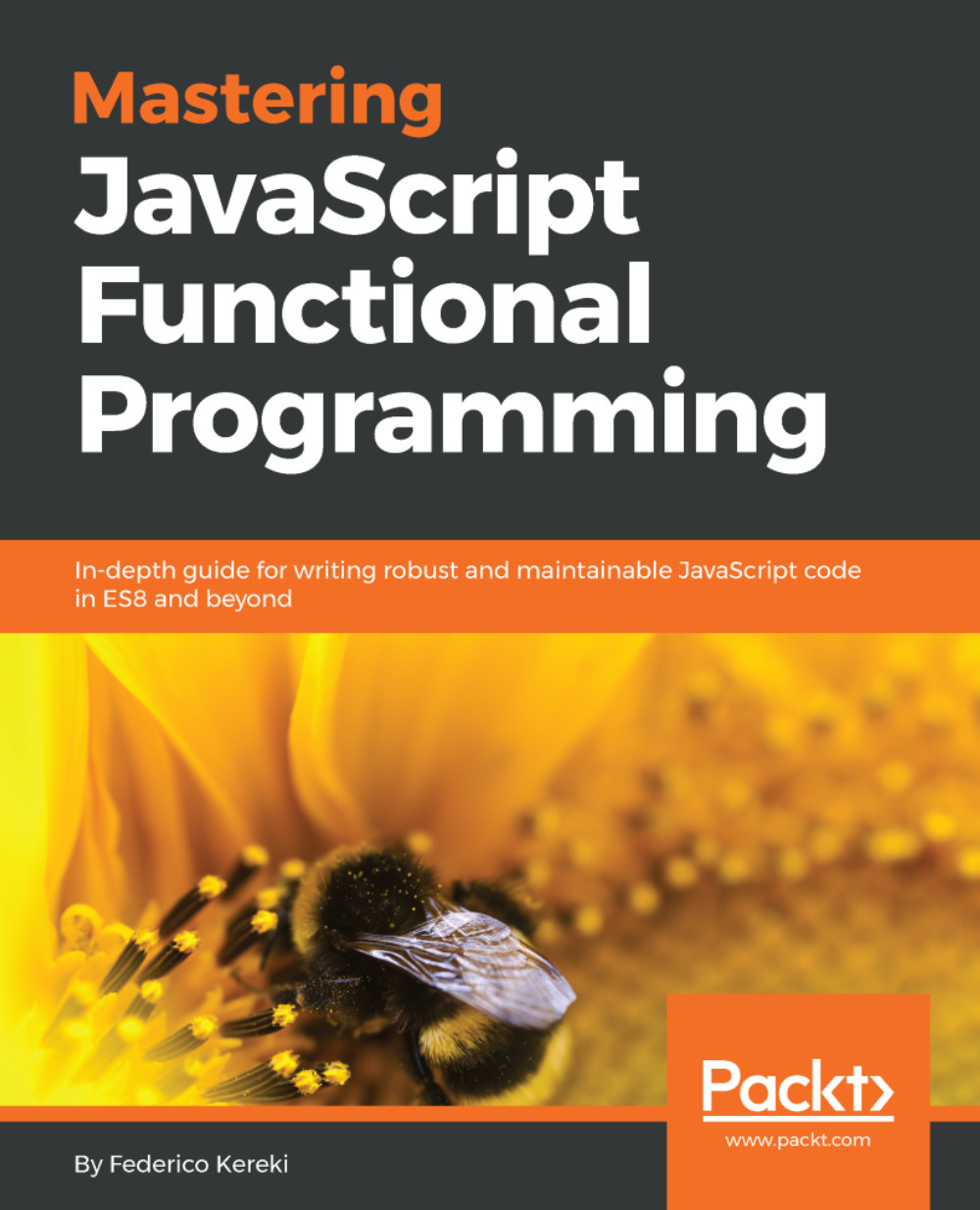
Mastering JavaScript Functional Programming

Mastering JavaScript Functional Programming

By : Federico Kereki
4.6 (7)
close
close
Mastering JavaScript Functional Programming

Mastering JavaScript Functional Programming

4.6 (7)
By: Federico Kereki

Overview of this book

Functional programming is a programming paradigm for developing software using functions. Learning to use functional programming is a good way to write more concise code, with greater concurrency and performance. The JavaScript language is particularly suited to functional programming. This book provides comprehensive coverage of the major topics in functional programming with JavaScript to produce shorter, clearer, and testable programs. You’ll delve into functional programming; including writing and testing pure functions, reducing side-effects, and other features to make your applications functional in nature. Specifically, we’ll explore techniques to simplify coding, apply recursion for loopless coding, learn ways to achieve immutability, implement design patterns, and work with data types. By the end of this book, you’ll have developed the JavaScript skills you need to program functional applications with confidence.
Table of Contents (22 chapters)
close
close
Dedication
Title Page
Credits
About the Author
About the Reviewer
www.PacktPub.com
Customer Feedback
Preface
8
Connecting Functions - Pipelining and Composition
chevron up
1
Bibliography
2
Answers to Questions

Composing


Composing is quite similar to pipelining, but has its roots in mathematical theory. The concept of composition is simple - a sequence of function calls, in which the output of one function is the input for the next one - but the order is reversed from the one in pipelining. In the latter, the first function to be applied is the leftmost one, but in composition, you start with the rightmost one. Let's investigate this a bit more.

When you define the composition of, say, three functions, as (f∘ g∘ h) and apply it to x, this is equivalent to what you would write as f(g(h(x))). It's important to note that, as with pipelining, the arity of the first function to be applied can be anything, but all the other functions must be unary. Also, apart from the difference as to the sequence of function evaluations, composing is an important tool in FP, because it also abstracts implementation details (putting your focus on what you need to accomplish, rather than on the specific details for achieving...

CONTINUE READING
83
Tech Concepts
36
Programming languages
73
Tech Tools
Icon Unlimited access to the largest independent learning library in tech of over 8,000 expert-authored tech books and videos.
Icon Innovative learning tools, including AI book assistants, code context explainers, and text-to-speech.
Icon 50+ new titles added per month and exclusive early access to books as they are being written.
Mastering JavaScript Functional Programming
notes
bookmark Notes and Bookmarks search Search in title playlist Add to playlist font-size Font size

Change the font size

margin-width Margin width

Change margin width

day-mode Day/Sepia/Night Modes

Change background colour

Close icon Search
Country selected

Close icon Your notes and bookmarks

Confirmation

Modal Close icon
claim successful

Buy this book with your credits?

Modal Close icon
Are you sure you want to buy this book with one of your credits?
Close
YES, BUY

Submit Your Feedback

Modal Close icon
Modal Close icon
Modal Close icon